DOCA vs Small Business Restructuring Plan
DOCA vs Small Business Restructuring Plan (SBRP): Understand the differences between a DOCA and small business restructure (SBR). Choose the right path for your company facing insolvency.
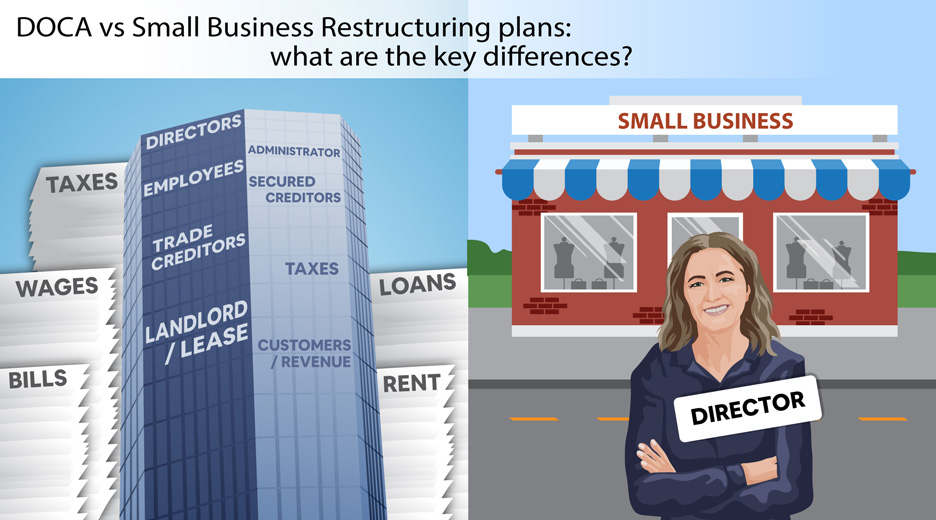
Learn about the differences between Deeds of Company Arrangement (DOCA) and Small Business Restructuring Plans
When an Australian company becomes insolvent, or is about to become insolvent, Directors have a difficult decision to make: Which turnaround or restructuring mechanism is best for them and for their business?
For decades, the main formal mechanism for restructuring a company has been Voluntary Administration, and a subsequent Deed of Company Arrangement (DOCA), developed via that process. However, since 2021, directors of small companies have had a second option, the Small Business Restructuring (SBR) regime (as governed by Part 5.3B of the Corporations Act 2001 (Cth)).
The end goal of both SBR and Voluntary Administration is a debt compromise — the DOCA in the case of Voluntary Administration and the Restructuring Plan in the case of SBR. Both DOCAs and SBR Restructuring Plans share the aim of trying to avoid liquidation by getting creditors to agree to settle their debts for less than their full value.
However, there are important differences between both forms of debt compromise. In this article, we’re going to look at what the key differences between them are. And then finally, we’re going to give some suggestions about when each option might be the correct one for your business.
What is a DOCA?
A DOCA is a binding agreement between a company and its creditors as an outcome of the Voluntary Administration process. It is governed by Part 5.3A of the Corporations Act 2001 (Cth). The process for arriving at a DOCA usually proceeds as follows.
- One or more directors realize that their company is insolvent or is likely to become insolvent.
- The directors of that company make a resolution to appoint a Voluntary Administrator: An independent insolvency professional who will attempt to save the business or, failing that, get the best possible return for creditors.
- The Voluntary Administrator accepts the appointment and takes control of the business. From this point on, there is a moratorium on enforcement of debts.
- The Voluntary Administrator investigates the company’s affairs, engages with creditors, and prepares a report for creditors.
- Creditors meet to vote on the company’s future, taking into account what the Voluntary Administrator has indicated in that report. The creditors must either agree to the DOCA, to end the Voluntary Administration, or to liquidate the company.
- If the DOCA is approved by a majority of creditors in number and value, a Deed Administrator is then appointed to implement the DOCA which will become binding on all unsecured creditors. For more information on the DOCA process check out our guide to DOCAs and their limitations.
What Is a SBR Restructuring Plan?
The SBR process is designed for small to medium-sized enterprises with relatively small debts. The key idea is giving viable small businesses a cheap and fast way to restructure their debts while remaining in control of the business.
The process usually proceeds as follows.
- The Directors form the view that the business is insolvent or likely to become so they make a resolution to start the restructuring process and appoint a Restructuring Practitioner. A Restructuring Practitioner, like a Voluntary Administrator, is a specially qualified insolvency practitioner.
- The Restructuring Practitioner then accepts the appointment and notifies ASIC and creditors. This triggers the moratorium on creditor action.
- The Directors then have 20 business days to propose a Restructuring Plan to creditors, prepared with the assistance of the Restructuring Practitioner.
- Once the Restructuring Plan is presented to creditors with the Restructuring Practitioner’s recommendation, creditors have 15 business days to vote. Approval requires that a majority by value of creditors agree to the restructuring plan. Usually, the ATO has the majority vote.
- Once approved, the Restructuring Practitioner oversees the implementation of the plan, i.e. the repayment and distribution of funds. Once the restructuring process is complete, the business returns to its ordinary operations.
The SBR regime has exploded in popularity since its introduction. While only 82 were undertaken in the first 18 months of the process, by 2025 there have now been 4,000 initiated. Their popularity coincides with a positive initial success rate of 79%.
To read more about the success of the SBR model, check out Ben Sewell’s recent assessment in the Journal of the Law Society of New South Wales (NSW).
What Are the Key Differences between a DOCA and a Small Business Restructuring Plan?
Although both DOCAs and Restructuring Plans provide a lifeline to distressed companies, they are quite different. Here we work through the key differences, one-by-one.
- Eligibility
DOCAs are available to any insolvent company that has entered the Voluntary Administration process, usually following the recommendation of the Voluntary Administrator to creditor that they should approve of the director’s compromise proposal. There are no restrictions on the size of debt, company structure or the industry. There is also no requirement that the company be up-to-date with its tax lodgements, or explicit restriction on using the process multiple times.
By contrast, SBR is only available to companies with liabilities under $1 million. In addition, it’s required that the company is up to date with all employee entitlements, including Superannuation, and that all tax lodgements have been completed. Furthermore, both the company and any of its directors cannot have used SBR within the last seven years.
So when it comes to eligibility you might say that SBR plans are really only available to small businesses that have met stringent standards. Voluntary Administration/DOCAs are more of a ‘free for all’ when it comes to eligibility.
- Who Remains in Control?
Once a company has entered into Voluntary Administration, the Voluntary Administrator takes full control of the business from directors. The Voluntary Administrator can choose whether they wish to continue trading or not.
By contrast, in SBR, the directors remain in full control of the business on a day-to-day basis, i.e., it is a ‘debtor-in-possession’ regime. While the Restructuring Practitioner has an oversight and advisory role, they don’t directly run the business.
This means that SBR is more Director-friendly in the sense that Directors can continue to trade and earn an income while the process is ongoing. This is especially true, given that Voluntary Administrators often don’t choose to continue trading so that the business can look effectively ‘finished’ to consumers and vendors.
- Process and timeline
On paper, the timelines for DOCAs and Restructuring Plans may look similar. Voluntary Administrators must convene the ‘2nd meeting of creditors’ within 20 to 25 business days of the process beginning. However, extensions are very common with Voluntary Administrations often lasting many months.
SBR, in practice, is much shorter with the Restructuring Plan needing to be submitted to creditors within 20 business days and creditors having 15 business days to vote.
- How the DOCA/SBR Plan Gets Approved
As mentioned earlier, a DOCA requires approval by both a majority in number and value of creditors who are voting. This means even small creditors are able to block proposals.
SBR Restructuring Plans, by contrast, require a majority by value only. This means that overall voting power is tilted towards large creditors in the SBR process. As the largest creditor is usually the ATO and the ATO is broadly supportive of the restructuring process, this suggests why the small business restructuring process continues to be so successful.
Another difference is that, in SBR, related parties are excluded from voting on the Restructuring Plan. This includes Directors, shareholders, family members of Directors/shareholders and Directors/shareholders of related bodies corporate.
Related parties are permitted to vote on DOCAs as long as they have ‘proved their debt’ with the Voluntary Administrator (i.e., shown it to be genuine). However, the court does have the power to overturn these votes under section 600A of the Corporations Act 2001 (Cth) where the voting of related parties was “against the interests of the creditors as a whole or is unreasonably prejudicial to the interests of the creditors who voted against the proposed resolution”.
- Flexibility of the Plan
As mentioned earlier, the DOCA process is very flexible. It could involve debt write-downs, asset sales, debt-equity swaps or customized repayment schedules. This reflects the broad language used in section 444A(4) to “make provision for the business, property and affairs of the company”.
Restructuring Plans are, in practice, more limited in scope. Due to the way in which the compulsory plan template is constructed, they usually involve straightforward repayment proposals using existing company resources.
In short, any more ‘imaginative’ restructuring proposals will need to go through the DOCA process.
- Cost of DOCA vs SBR Plans
DOCAs are, almost always, expensive to implement. Voluntary Administrators/Deed Administrators charge high hourly rates. And while no official statistics are kept, the most recent research from Professor Jason Harris suggests that the total cost of voluntary administration is $60,000 to $100,000+. That’s for the full Voluntary Administration and Deed Administration process.
SBR is much cheaper. Fees must be fixed in advance, typically costing (in total) between $20,000 and $30,000. Overall, the predictability and lower cost of small business restructuring can make it a much more viable option for small businesses.
- Outcome if the Plan Is Rejected
If a DOCA is rejected, the company then automatically enters into the liquidation process to be wound up.
By contrast, in SBR, if creditors reject the plan, the process is simply over, with Directors remaining in control of the company. This means Directors may then choose another option, such as Voluntary Administration or informal negotiations (with the proviso that Directors are still under an obligation not to allow insolvent trading).
Overall, you might say that small business restructuring is less ‘terminal’: Directors have other options after failure, so there’s less at stake by entering the process.
Which Option is Best for your Business?
There is no one size fits all restructuring solution. Australia intentionally has different mechanisms available for different types of business. The best choice for you is going to depend on the size of your debts, how the debt is distributed amongst creditors, and the nature of your own business.
For most small businesses in Australia, it’s going to be straightforwardly the case that SBR is preferable. For example, a cafe with several hundred thousand in income and GST debt, but otherwise viable, would benefit from this process: The costs are much lower; Directors can continue to operate the cafe and make money as the process continues; it will move quickly; if it fails, there are still other turnaround options.
Obviously, for companies that are ineligible for small business restructuring, then a DOCA may be more appropriate. Though in that situation, it is worth businesses considering the pros and cons of other turnaround options, such as utilizing the Safe Harbour.