Deeds of Company Arrangement (DOCAs) for Transport Companies
Understand Deeds of Company Arrangement (DOCAs) for transport companies facing financial distress. Learn how a voluntary arrangement can help a company and its creditors.
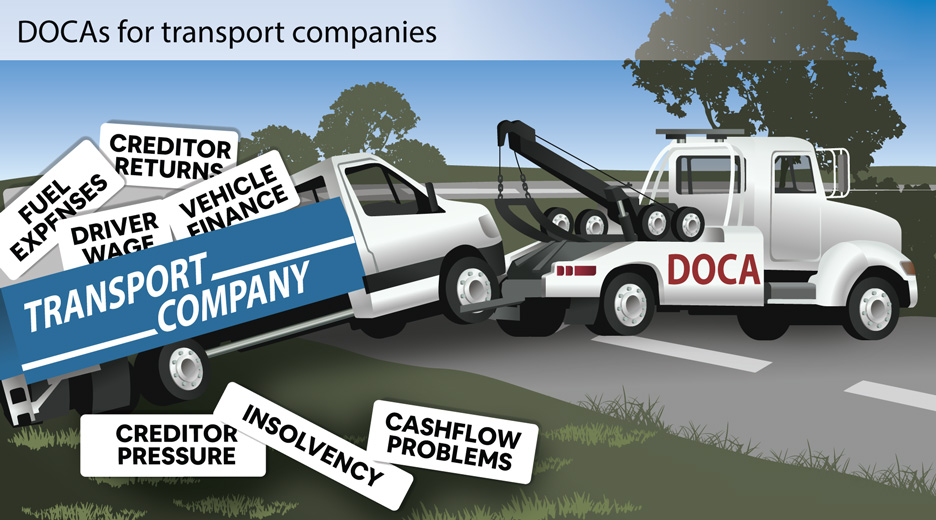
Table of contents:
Deeds of Company Arrangement (DOCAs) are a key restructuring tool for insolvent companies. Here we look at how a DOCA might work for transport and logistics businesses.
For transport and logistics companies facing financial distress, implementing a Deed of Company Arrangement (DOCA) through Voluntary Administration can be a viable way to avoid liquidation. This article explains how the DOCA process works, and when it might be preferable for transport companies in comparison to Safe Harbour restructuring, Small Business Restructuring or Liquidation.
Why Might Transport Companies Consider a DOCA?
When a transport company is insolvent or likely to become insolvent, directors need to act swiftly in order to fulfil their obligation to prevent the company from trading while insolvent (see section 588G of the Corporations Act 2001 (Cth)).
Transport companies face a distinct mix of financial pressures that make corporate insolvency a real risk. These include:
- Thin margins and fixed-rate contracts, often locked in before fuel, insurance, or wage costs increase
- Fleet finance and operating leases, creating high fixed repayment obligations
- Driver shortages, leading to wage pressure and operational disruption
- Subcontracting models, including owner-drivers, where payment delays cascade
- The rise of autonomous vehicles. The rise of the autonomous vehicle is going to make the industry more competitive in the future. It can be expected that capital requirements will increase and the expectations of the customer will increase to require more precise results and lower prices.
These pressures can lead to a cashflow crunch and trigger insolvency quickly, even if the business would otherwise be viable. Read more about the financial pressures that transport businesses face in ‘Avoiding the Wall’.
If the shareholders are unwilling to initiate winding up, the directors of an insolvent transport company could try and restructure the company’s debt. This can be attempted via:
- An informal workout with creditors and/or rescue financing. The ‘safe harbour’ from insolvent trading under section 588GA of the Corporations Act 2001 (Cth) gives directors room to negotiate directly with creditors, or attempt to secure extra working capital/rescue finance. But with a fragmented creditor base that could include fuel suppliers, financiers, owner-drivers, landlords, and the Australian Tax Office (ATO), this is often impractical. This approach is at risk of ‘hold-out’ creditors and creditors (such as the ATO) who aren’t prepared to take a haircut without a formal procedure being initiated (like Voluntary Administration).
- Appointing a Restructuring Practitioner, where eligible for Small Business Restructuring. Restructuring under Part 5.3B of the Corporations Act 2001 (Cth) (commonly known as small business restructuring) is a fast, and cost-effective rescue mechanism, allowing directors to stay in control of the day-to-day business trading throughout. However, it has strict entrance criteria: It is only available to companies with total liabilities of less than $1 million that are otherwise up-to-date with their tax lodgements and employee entitlement payments. It is also only available where neither the directors or the company haven’t been through the process in the past seven years. You can read more about this option in our Guide to Small Business Restructuring.
- Appointing a Voluntary Administrator and executing a DOCA. Our focus in this article is discussing this third option in detail.
How Does the DOCA Process Work?
The DOCA process begins with directors resolving to appoint a Voluntary Administrator, an independent Insolvency Practitioner who will take control of the business from directors. Once the Voluntary Administrator agrees to the appointment, they begin to investigate the company’s affairs and prepare reports to creditors. Key steps in the Voluntary Administration process include:
- The First creditors’ meeting, dealing primarily with procedural matters, and giving creditors the opportunity to replace the Voluntary Administrator.
- Administrator’s report under s 439A, setting out options (DOCA, liquidation, or return to directors), and giving the Voluntary Administrator’s recommendation.
- Second creditors’ meeting, where creditors vote on the company’s future (to approve or reject any DOCA put to the creditors).
In practice, a DOCA arises where a director or a creditor has proposed one and usually when the Voluntary Administrator is willing to recommend it to creditors at the second creditors’ meeting.
If a DOCA is approved by the requisite majorities of creditors (50 percent in value and number), the company exits Voluntary Administration and the DOCA is implemented under the supervision of a ‘Deed Administrator’. Usually the Deed Administrator is the same person as the Voluntary Administrator, but they need not be.
It is worth noting that while ‘ipso facto’ clauses are stayed during Voluntary Administration, that protection does not continue once a DOCA is in effect. This means that once the Voluntary Administration is over, there is a real chance that suppliers will cancel their contracts. This can be an especially acute problem for transport companies, as once the DOCA commences, freight and logistics contracts, principal–carrier agreements, fleet leases and fuel supply contracts may be terminated. Any viable DOCA for a transport company must anticipate these risks and, where possible, address them through pre-negotiation or contingency planning. Often the unsecured creditors (such as the ATO) bear the brunt of the haircut that creditors take through a DOCA and the rights of secured creditors (such as fleet leases) are preserved.
The ATO is frequently the largest unsecured creditor in transport insolvencies, so their agreement to any proposed DOCA is usually vital. In general, the ATO places strong emphasis on tax lodgement compliance, so directors will need to ensure they are substantially compliant with tax lodgments if they expect the ATO to support a DOCA. The ATO will also be sensitive to whether the transport company has unpaid superannuation and other employee entitlements. The ATO may reject a DOCA for policy reasons rather than financial reasons.
What Might the DOCA Cover?
DOCAs are inherently flexible mechanisms, with few mandatory requirements. Some restructuring options that are commonly organised via a DOCA include:
- Debt compromise and repayment restructure. The core feature of most DOCAs is a compromise of unsecured creditor claims. Creditors agree to accept less than what they are owed, with payments made either as a lump sum or over time. In the transport context, funding for these payments often comes from ongoing freight operations, the realisation of non-essential assets (for example, surplus vehicles), or fresh funding (e.g., from an existing creditor). The DOCA will usually specify the payment schedule, priority of distributions, and the consequences of default, allowing creditors to assess whether the proposal offers a better return than liquidation.
- Asset or business sale mechanisms. DOCAs frequently provide for the sale of assets or the business as a going concern, either immediately or following a short trading period. For transport companies, this may include the sale of trucks and trailers or the sale of an operating business. Where a sale is contemplated, the DOCA can bind creditors to the transaction, reducing the risk of subsequent challenges and providing certainty to purchasers, an outcome that is often difficult to achieve outside a DOCA structure.
- Governance and capital restructuring measures. In some cases, DOCAs also address governance and capital structure issues. Where appropriate, a DOCA may provide for debt-for-equity conversions, particularly where major creditors are willing to support the business long-term.
Transport-Specific DOCA Pitfalls
There are some specific matters that transport companies should be aware of when considering a DOCA.
- DOCA finance. In contrast to other jurisdictions there are no mechanisms for DOCA finance. A DIP loan (debtor-in-possession) in the US bankruptcy system allows the insolvent company to borrow money whilst going through a formal restructuring (to fund it) and the financier obtains a ‘super-priority’ over other creditors. The practical effect of this is that the Voluntary Administration process is usually short and sharp without a financier to fund it.
- Fleet finance and secured creditors. Transport companies are typically highly leveraged, with secured lenders often holding security over trucks, trailers, and other rolling stock. Within 13 days of appointment of the Voluntary Administrator, secured creditors have the option to appoint a receiver, which, depending on the extent of the security interest, can render the Voluntary Administration pointless. But more importantly, whether or not they appoint a receiver during the Voluntary Administration, a DOCA cannot compel a secured creditor to compromise without their consent. In short, where secured lenders are unsupportive, a DOCA may be commercially unworkable from the outset.
- Fuel supply and credit withdrawal. Fuel suppliers commonly operate on short credit terms and are quick to revert to cash-on-delivery following insolvency. Even where supply continues during Voluntary Administration, there is no obligation for suppliers to maintain terms once a DOCA begins. DOCAs that rely on continued trade credit for fuel without secured arrangements or pre-payment buffers often collapse quickly.
- Owner-driver and subcontractor churn. Transport DOCAs frequently underestimate the behavioural response of owner-drivers and subcontractors. Even if past debts are compromised, subcontractors may refuse to continue working without immediate payment certainty or higher rates. Because labour is mobile and relationships are informal, DOCAs can unravel operationally despite being legally sound.
Creditors’ and Subcontractors’ Perspective
So far, we have been considering what the directors of the transport company need to consider. Creditors will have a very different perspective. Before supporting any proposed DOCA, they will need to consider:
- Their return in comparison to historical averages. Unsecured creditors will receive an estimate about their projected return from a DOCA (as a percentage of debt owed). Over time this return has diminished for unsecured creditors in Australia. Going down from ~20% to ~10%. However, the comparison to liquidation is favourable given that creditors can usually expect zero return from an insolvent liquidation.
- Their classification (secured, priority, unsecured), and how that is dealt with in the DOCA. Creditors who would be preferred creditors in liquidation may consider litigation where the DOCA is discriminatory.
- Treatment of related-party and insider claims. Creditors should scrutinise whether related-party creditors (including directors, their family members, or related entities) are being treated on the same basis as arm’s-length creditors.
- Exit risk and default consequences. Creditors should assess what happens if the DOCA fails. Are assets already dissipated or further encumbered by the time of failure? A DOCA that worsens creditor position on default, by consuming cash, eroding asset value, or increasing secured debt, may be less attractive than immediate liquidation.
Practical steps creditors should take as part of the Voluntary Administration and the subsequent Deed Administration process include:
- Reading creditor reports and voting at creditors’ meetings
- Seeking the appointment of a committee of inspection, to oversee the Voluntary Administration
- Closely scrutinising DOCA financial assumptions
- Comparing projected DOCA returns with liquidation returns to creditors
DOCAs for Transport Companies: Our Take
DOCAs can be a useful rehabilitation tool for transport companies, particularly where Small Business Restructuring is unavailable. However, high exposure to secured fleet finance, reliance on terminable contracts, and tight operating margins will make DOCAs difficult to negotiate. If you’re the director or creditor of a near-insolvent transport company, get in touch to determine which restructuring/re-organisation option might best suit your business.