Preventing Voluntary Administration: Essential Steps for Company Directors of SMEs
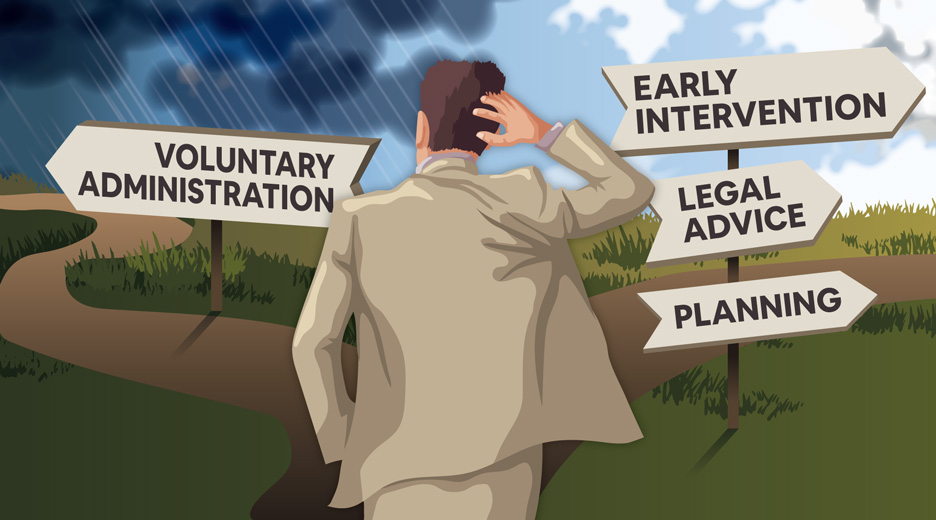
Voluntary administration is not always the best option for small-to-medium sized enterprises in Australia. While it is sometimes successful for larger businesses, often other turnaround and restructuring options are more suitable for SMEs. Here we look at some of the reasons you might have for avoiding voluntary administration.
We have already discussed How to prepare for a voluntary administration, and here we set out the steps you need to take to avoid a voluntary administration in the first place. In short:
- Voluntary administration is only a live option for directors where the company is insolvent or likely to become so. Get your accounting file in order so that you know whether you are in that situation;
- Avoidance is about quickly implementing good business practices – usually aggressive downsizing and addressing the root causes of business problems;
- Once on the brink of insolvency, voluntary administration becomes a live option. But the loss of control to someone with less incentive to turnaround the business is a big risk to take if you are serious about engineering a restructure. This may mean Restructuring under Part 5.3B of the Corporations Act 2001 (small business restructuring) or utilising the Safe Harbour protection are more appropriate;
- Voluntary administration is often a ‘Hail Mary’ – something to consider when all other options are exhausted. It protects directors and creates a short moratorium on legal action, and can be a successful turnaround option in some cases.
A recap on voluntary administration
When the directors of a company come to the conclusion that the company is insolvent, or is likely to become insolvent, they have the option to enter into voluntary administration. This involves an independent, suitably qualified individual taking control of the business from directors. Their goal is to save the company through compromise – a ‘Deed of Company Arrangement’ (DOCA) – with creditors.
During the voluntary administration, creditors cannot pursue claims against the company and they are unable to call in personal guarantees pledged by directors either.
It is important to note that voluntary administration is rarely forced upon directors, usually only in cases of appointment by a secured creditor. A formal insolvency appointment is sometimes mandated by law – including the requirement not to trade whilst insolvent.
There are several features of voluntary administration that mean it may not be the best option for small businesses:
- Director loss of control. Directors have the drive to keep the business going – and not just for financial reasons. For most small to medium-sized enterprises (SMEs), the director’s business is their passion. The voluntary administrator often stops trading the business altogether.
- Expense. Voluntary Administrations are expensive — estimated at $30-50,000 on average. And that doesn’t include the costs of administering any subsequent DOCA. This is money that comes out of the business’s asset base and cannot otherwise be used to keep the business trading or turn it around.
Factors which may lead to insolvency
The key to avoiding any formal insolvency appointment (whether Voluntary Administrator, Restructuring Practitioner or Liquidation) is avoiding insolvency. Insolvency is defined in section 95A of the Corporations Act 2001 as the inability to pay debts as they become due and payable.
Whether a company is in a state of insolvency is a holistic question, depending on the facts of the case. In ASIC v Plymin & Ors (2003) 46 ASCR 126, the Supreme Court of Victoria set out a range of key indicators for insolvency. Important indicators included continuing losses, overdue taxes, a poor relationship with the bank, inability to raise equity, unpaid creditors and judgments or warrants issued against the company.
But these are indicators that all apply after a business is already in difficulty. What are some of the fundamental contributors to insolvency to look out for? While it depends on the industry and business in question, some of the key contributors include:
- Poor bookkeeping. It is common for directors of SMEs who are devoted to the day-to-day running of the business itself to fall behind with their financial recordkeeping. This is a sure-fire way for debts – particularly tax debts – to get out of hand;
- Poor cost accounting. This is related, but distinct, from the last point. It is common for directors with poor bookkeeping practices to lose track of the real cost of their goods and services which can lead to consistent under-pricing;
- ‘Overtrading’. Often SMEs try and grow too quickly. They take on too much work, requiring extra investment in capacity where there is insufficient cash to fund it.
None of those contributors are decisive, however. In this author’s view, the most common proximate cause of insolvency in SMEs is ‘ostrich syndrome’. Business owners are often embarrassed by our own deficiencies, and instead of facing the problems head on as they arise, we hide from them.
There is also a vicious cycle for businesses in financial difficulty. At the point of insolvency, directors often spend most of their time putting out fires (working in the business not on the business). And in doing so they may lose sight of whether their pricing, employee retention and overall strategy continues to be viable.
Avoiding getting to the point of insolvency
While there are some mechanisms available to a business to help them survive if they do reach the point of insolvency (see our discussion of the safe harbour below), unless the business is economically sustainable, they only delay the inevitable. Ultimately, directors have to take early action to get their business back on track. Every company in financial difficulty needs to:
- Get early strategic business advice. This can be difficult for SMEs – there may be few advisers who can assist. The business’s usual accountant may be too busy to provide this kind of advice. A bespoke approach to achieve a better outcome is essential;
- Get the bookkeeping in order. Get a complete write-up through an accounting software package such as MYOB or Xero, to see what figures you are working with;
- Slash expenses. All non-essential expenses need to be cut because it is faster to cut expenses than it is to increase revenue;
- In accordance with employment laws, terminate under-performing and non-performing employees. When your business is in difficulty, you cannot afford for your time and money to be sucked up by bad employees;
- Don’t forget the income side of the equation. You should consider turning the speed of your payment terms up a notch to increase cash flow;
- Don’t wait to pivot on strategy. While the business is on the brink of insolvency, you may need to make some bold moves. If you see high-value opportunities you need to take them as soon as possible.
Once on the brink of insolvency, is voluntary administration the only option?
Recall that directors aren’t legally required to choose voluntary administration. If the business is insolvent or likely to become insolvent, the directors need to make a decision as to whether an administration appointment is the best step for them. Other options which may be more effective are small business restructuring or utilising the safe harbour from insolvent trading.
The safe harbour under section 588GA of the Corporations Act 2001, means that directors are not personally liable for allowing insolvent trading where they “start to develop a course of action” for the purposes of turning around the business.
If the business has debts of less than $1 million and has paid out employee entitlements and ATO debt, it is eligible for small business restructuring. In this process, the directors appoint an independent professional, a Restructuring Practitioner to develop a restructuring plan to turn around the business. The business has 20 days to come up with such a plan, and if accepted by a majority of creditors in value, the business is restructured and can trade anew.
Crucially, while the restructuring process is underway, the business is able to continue to trade, under the control of directors, and directors are not made liable for allowing insolvent trading.
Making the decision to appoint a voluntary administration
In some cases, utilising the safe harbour or small business restructuring will not be appropriate for an insolvent business: The debts may be too large for small business restructuring or there may be creditor legal action that stops the directors from using the safe harbour to develop a restructuring plan. In such a case, voluntary administration could be the last option to have a decent chance of achieving a reasonable compromise with creditors and saving a business from liquidation.
In other cases, directors might feel that liquidation is inevitable, and desire voluntary administration in order to get their affairs in order and start an orderly liquidation process. During the voluntary administration, any personal guarantees directors have made for company loans cannot be enforced and the voluntary administrator would be better placed to sell going-concern assets than a liquidator.
Key takeaways
- The first step to avoiding voluntary administration is avoiding insolvency itself. The key message here is: don’t be an ostrich. When things start going off-track, take a deep breath and seek professional advice to try and turn things around;
- Once insolvency is on the horizon, voluntary administration might still be avoided. You can seek professional advice on small business restructuring, or utilising the ‘safe harbour’ in the Corporations Act 2001
- There may be some cases where all other options are inappropriate, and you should appoint a voluntary administrator.